What a Place Name Can Suggest, and What It Cannot Prove
Learn how to read a place name for landscape clues, check older spellings and maps, and distinguish a plausible hint from a documented explanation.
The commonest mistake with a place name is to treat a familiar-looking word as a finished explanation. That can send you searching for a vanished wood, ford or hill that the name never securely described. Read carefully, though, place names can offer useful landscape clues—as long as a hint stays distinct from a claim.
Start with the exact name
Write down the name as it appears on a current map, and note what it labels: a village, farm, stream, neighbourhood or field. Similar names can refer to different kinds of places, and a label may have shifted its reach over time. Keep the spelling, spacing and punctuation as printed.
Then collect older spellings from reliable local sources, such as historic maps, parish records, county place-name volumes or a local archive catalogue. Record each form’s source and the feature it names. An old spelling is not automatically the original one: a clerk may have written a sound as it seemed to them, or a mapmaker may have copied an earlier map.
Consider pronunciation as well as letters. Everyday speech can reshape a name, and words that look alike now may have arrived by different routes. If you cannot identify a credible earlier form, keep any interpretation tentative.
Split possible elements
Try dividing the name into parts only after gathering its recorded forms. Common elements in British place names may refer to features such as a hill, stream, marsh, wood, settlement or crossing. Their meanings depend on language, region and period; an element familiar in one county may not carry the same meaning elsewhere.
Check candidate meanings in a county place-name reference or a reputable language dictionary. Compare the recorded spellings with the proposed element instead of choosing a meaning because it suits the scenery. A plausible sound match is a lead, not a verdict.
The name might also come from a personal name, a neighbouring settlement, a boundary marker or a feature that has disappeared. Today’s landscape is only part of the evidence: a stream may have been diverted, a wood cleared or a settlement expanded since the name arose.
Check the landscape clue
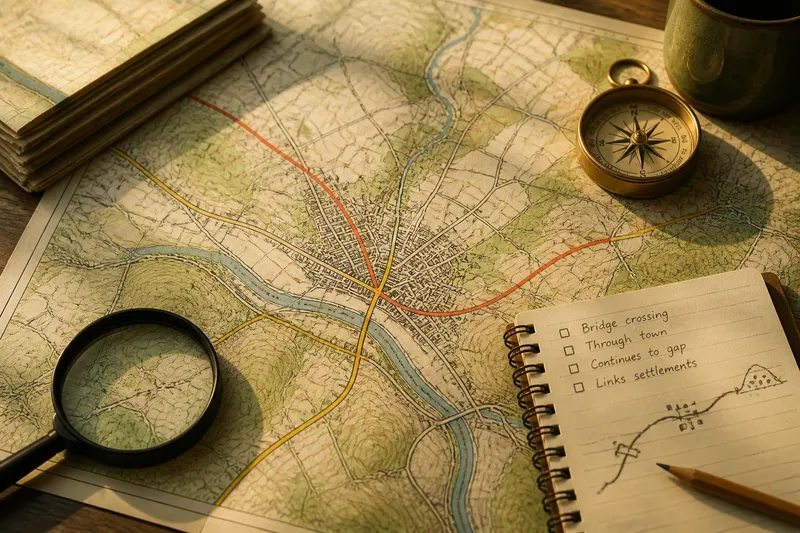
Inspect the place and its surroundings on an Ordnance Survey map, an aerial view and, where available, historic maps. Look for the specific feature suggested by the name: a change in slope, a wet hollow, a stream junction or a patch of woodland. Note what you can see and what you infer; a broad resemblance is not a precise match.
Ask whether the feature is close enough, prominent enough and positioned plausibly to have supplied a name. A hill-name element may fit one conspicuous rise better than a distant ridge. A name suggesting wet ground might suit a low hollow, though present drainage and land use can conceal earlier conditions.
Look beyond the settlement boundary shown on today’s map. A name may describe a nearby feature rather than the centre of the place. Equally, a matching feature close by may be coincidence, especially if the proposed word has several possible meanings.
Separate hint from proof
Sort your notes into three parts: what the recorded forms say, what landscape feature you can observe, and what remains interpretation. This keeps an appealing story from growing firmer each time it is repeated. It also exposes gaps: perhaps the word is uncertain, the feature has vanished, or the records do not connect the two.
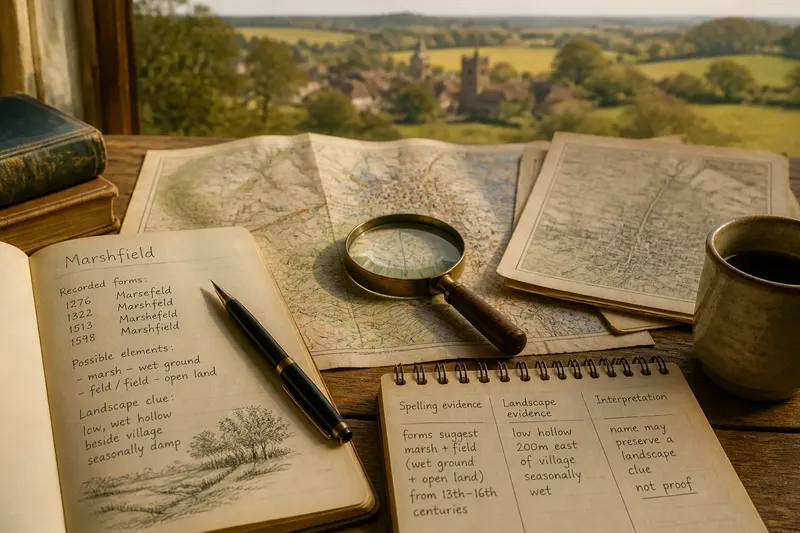
Say you are examining an invented village called Marshfield. Its old spelling seems to include a word for wet ground, and a low hollow beside the village looks like a plausible match. You note that the name may preserve a landscape clue, but without documentary evidence linking the name to that hollow, you do not claim it proves the village began there or that the whole area was marsh.
For a stronger explanation, seek documentary support that addresses the name itself: a local place-name study discussing its forms, an archival record, or a specialist account with cited evidence. A general dictionary can clarify an element but cannot establish why this particular place received its name. If records disagree, report the disagreement rather than smoothing it away.
What can the name tell you?
Can a place name suggest a vanished feature?
Yes, especially when older spellings and local records point in the same direction. The name alone cannot establish exactly where the feature lay or when it disappeared.
Do modern spellings preserve old meanings?
Not necessarily: spelling and pronunciation change, and familiar modern forms may disguise older words. Earlier recorded spellings help, but each needs its source and context.
Can a possible meaning go on a local map?
It can appear as a qualified note, such as “possibly refers to wet ground”, alongside a pointer to the evidence consulted. Avoid presenting an interpretation as fact when the documentary case is incomplete.
Keep the effort focused
It is not worth forcing every syllable into a neat translation or searching for a vanished feature simply because a modern word seems to promise one. Start with the strongest spelling evidence and investigate only the landscape clue it reasonably supports.
A careful reading of a place name can sharpen questions about a county’s landscape without pretending to settle them. The name may suggest a feature, a map may show a plausible match, and records may strengthen or weaken the connection. Keep those strands distinct, and even an uncertain interpretation can be useful.